
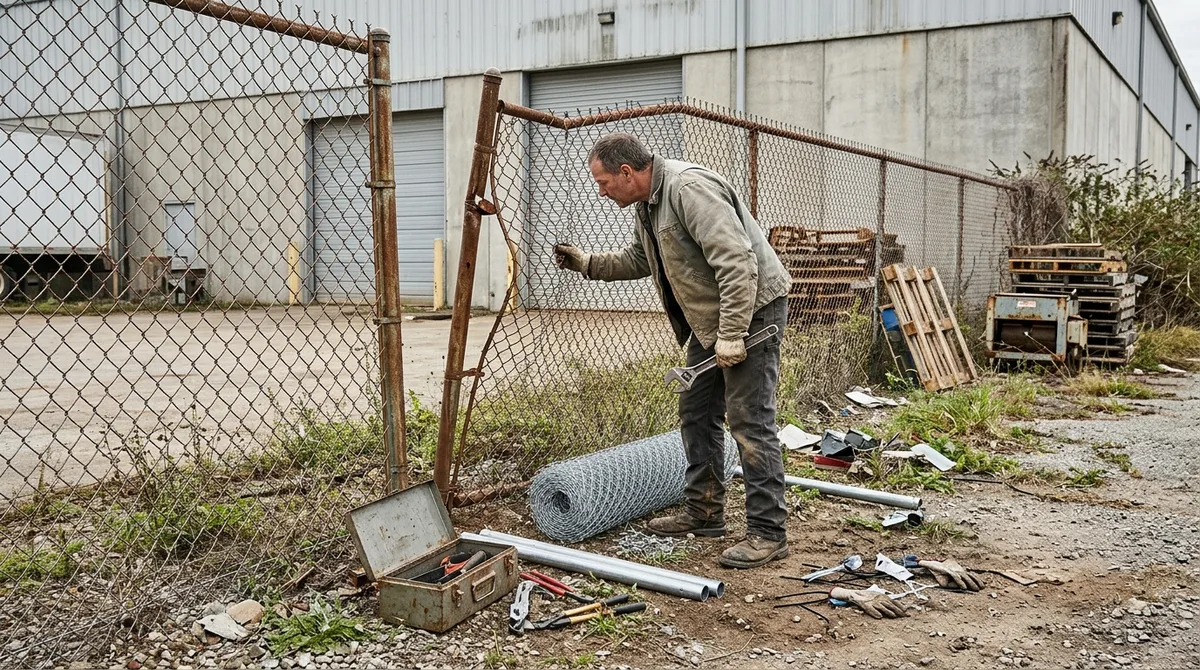
For commercial fence maintenance, we use an annual planning baseline of $1.25 per linear foot for chain link, $3.75 for wood or tubular fencing, and $6.25 for wrought iron, based on California’s Operating Cost Manual Addendum. These amounts are repair-and-replacement reserves. Budget finish maintenance separately: the state table lists $1 per square foot per side for wood paint or stain and $1.25 per square foot for tubular or wrought-iron paint.
In Los Angeles, fences must remain straight, structurally sound, and in good repair under Municipal Code Section 91.8104.13. That makes upkeep both a compliance concern and a budget item.
For annual planning, budget $1.25 per linear foot for chain-link repair and replacement, $3.75 for tubular fencing, $3.75 for wood, and $6.25 for wrought iron. Then account separately for finish maintenance. The finish allowances are $1 per square foot per side for wood paint or stain and $1.25 per square foot for tubular-fence or wrought-iron paint. To estimate a property’s reserve, multiply the installed fence length by the applicable per-foot rate. Calculate finish costs from the surface area that needs painting or staining, counting each side of a wood fence separately. For example, a wood fence’s repair-and-replacement reserve is based on length, while its finish allowance depends on the area of each side that needs treatment. The reserve benchmarks assume replacement lives of 17 years for chain link, 15 years for tubular fencing, 10 years for wood, and 20 years for wrought iron. These are budgeting allowances, not guaranteed contractor quotes. Actual costs depend on the fence’s condition and repair needs, so use the benchmarks as a starting point rather than a fixed annual bill.
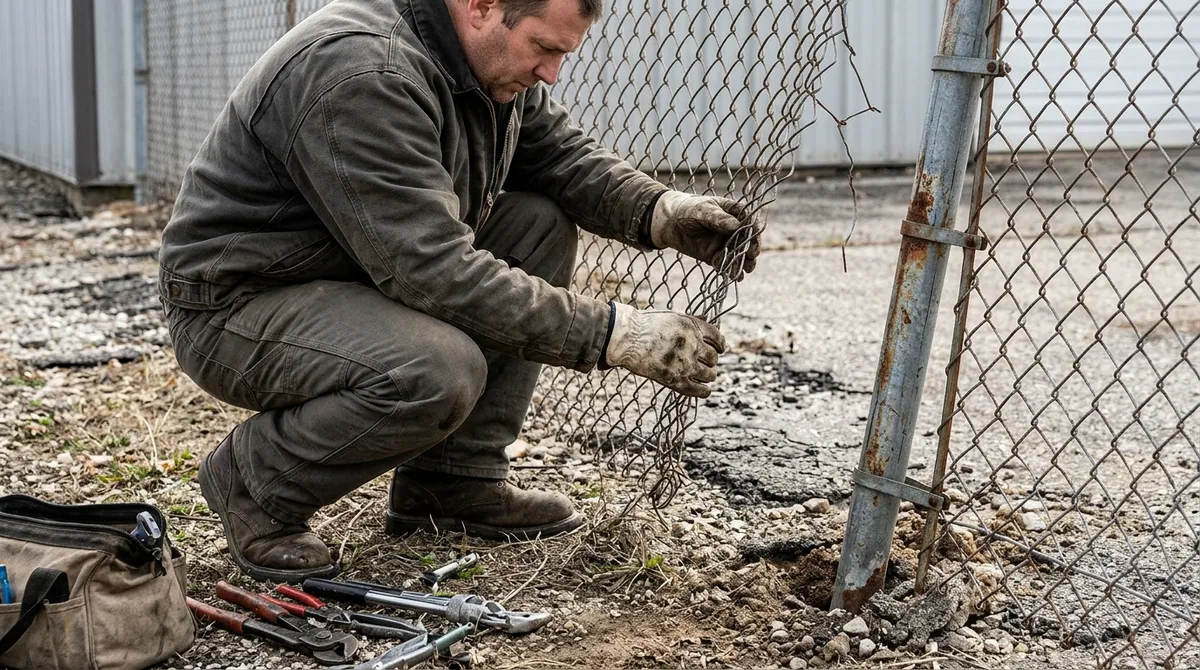
Commercial repair bids vary based on fence material, the type and extent of damage, the number of posts or sections affected, labor and materials, site access, and ground conditions.
Small-job prices in the area can include $80–$160 for a broken latch, $120–$220 to reset a sagging gate hinge, and $180–$340 for a single post replacement. Replacing several posts or rebuilding a damaged section takes more labor and materials than fixing one component. Difficult access or hard-to-dig ground can also add work.
Galvanized and vinyl-coated chain link are common options, with privacy slats, windscreens, and barbed wire available as add-ons. Working around these features can affect the repair scope. Gate hardware and security additions may also require extra parts, adjustment, or installation time.
Los Angeles rules can add upkeep work and limit fence height, affecting maintenance budgets and project scope.
Fences must remain in good repair, straight, uniform, and structurally sound. Wooden fences must be painted, stained, treated, or sealed to prevent weathering or deterioration. Privately owned exterior fences must also be free of graffiti visible from a public street or alley.
Under the City of Los Angeles Chapter 1A zoning standards, side- and rear-yard fences in Commercial-Mixed (CX) and Industrial-Mixed (IX) districts generally have an eight-foot maximum. A Class 1 Conditional Use Permit is required for a fence above eight feet when it is next to a lot outside an Industrial or Public use district.
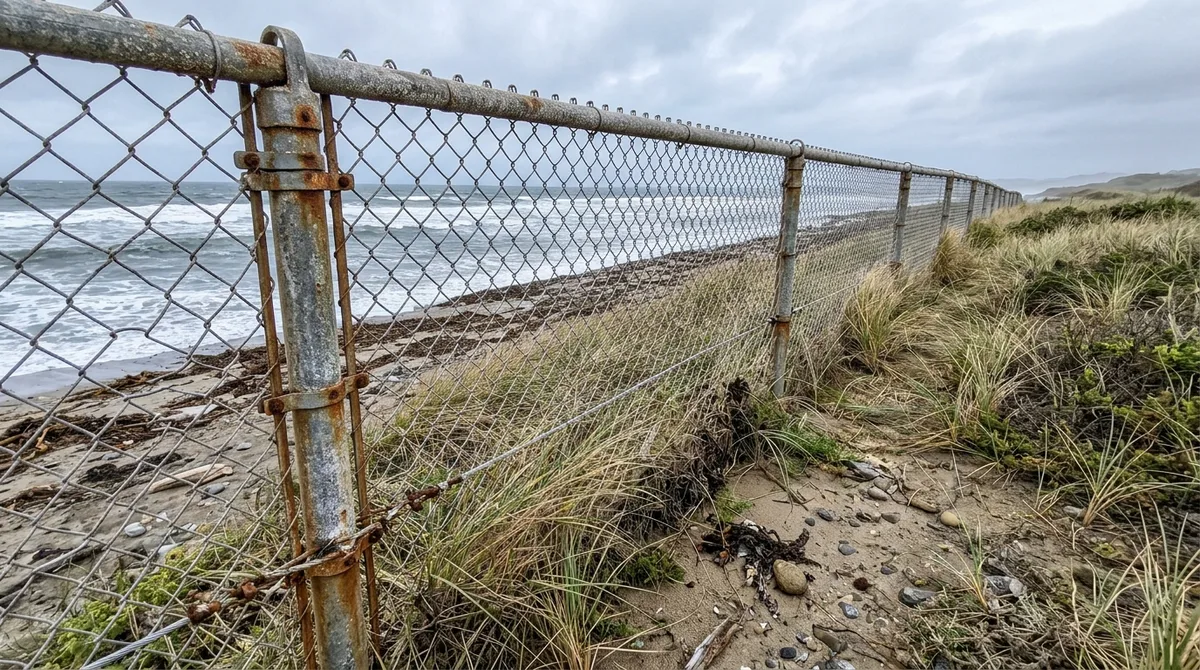
Yes. Coastal exposure can increase maintenance needs for metal fencing and hardware, though the added risk varies by site. FEMA’s NFIP Technical Bulletin 8 explains that salt spray is strongest near breaking waves, drops rapidly about 300–3,000 feet inland, and can contribute to accelerated corrosion 5–10 miles inland.
A fence near the surf in Santa Monica or Malibu may face different corrosion pressure from a more sheltered site farther inland. We recommend basing the maintenance budget on the property’s exposure and the condition of its metal components, rather than assuming one schedule fits every location.
Repair is usually cheaper for isolated damage, while replacement may make more financial sense when damage is widespread or repairs recur across many sections. The California State Board of Equalization’s 2025 Assessors’ Handbook AH 534.71 lists 11-gauge chain-link installation benchmarks of $24.04 per linear foot for a six-foot fence and $30.71 for an eight-foot fence.
The state’s Los Angeles-area replacement-cost table lists six-foot solid vinyl at $32.49–$52.54 per linear foot and six-foot redwood at $38.24–$54.80.
Our estimated installation prices are $20–$35 per linear foot for chain link, $40–$65 for wood, $40–$65 for vinyl, and $45–$60 for wrought iron. Costs vary with scope, material, terrain, and project specifics. Compare the damage pattern and extent, ongoing repair needs, and replacement scope instead of relying on one repair price.
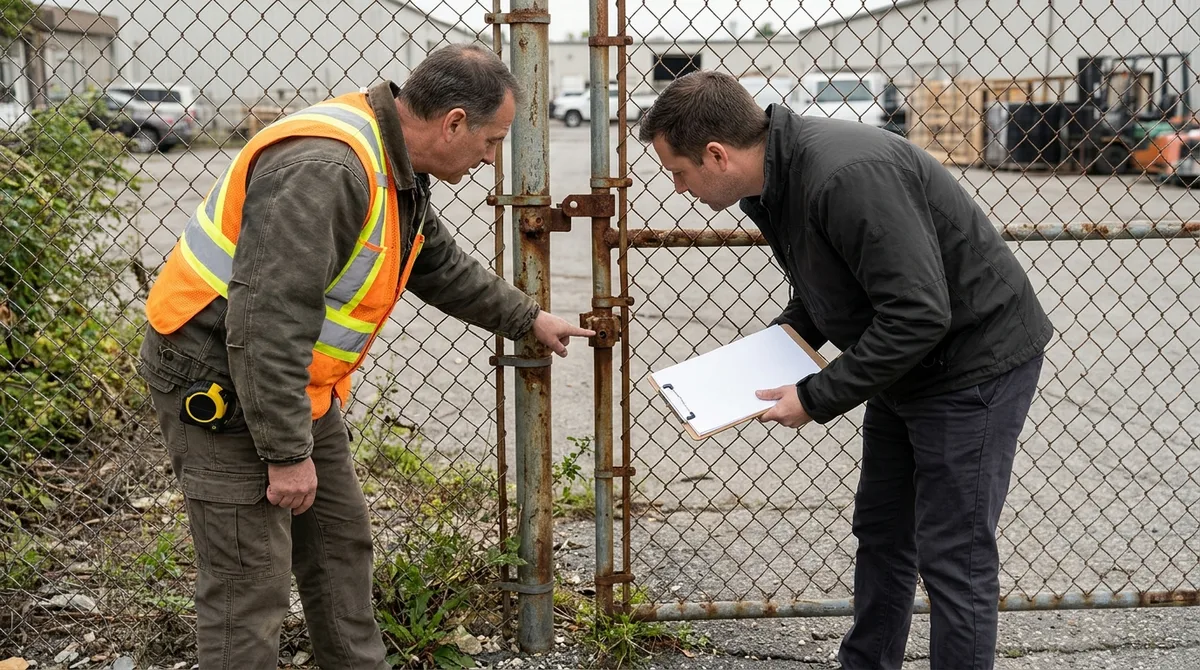
Compare commercial fence quotes by matching the repair scope and every included cost. Ask each contractor to identify:
Compare bids with the same scope, and ask which items are immediate repairs and which are optional improvements. We provide free estimates for residential and commercial fence and gate projects. For budgeting, record each quote’s scope, exclusions, and optional work separately, then use completed repair records to refine the property’s upkeep reserve.
To discuss a site-specific commercial fence or gate project, gather the property address, approximate fence length, material, and a list of issues such as loose posts, damaged panels, corroded hardware, or a gate that will not close. Photos of affected sections and notes about access restrictions can help clarify the project scope.
Call us at (424) 625-8561 to request a free estimate for a fence or gate project in Los Angeles, the San Fernando, San Gabriel, or San Bernardino Valley, or nearby communities such as Burbank, Glendale, Santa Monica, and the South Bay. Ask us to itemize urgent work and optional work separately, with the affected sections clearly identified.
Commercial property insurance may cover fence damage depending on its cause and the terms of the policy. Check your policy and ask your insurer whether the specific damage is covered before deciding how to handle the repair.
Cleaning costs depend on the fence material, the type and amount of buildup, and site access. Ask for a site-specific price that separates cleaning from repairs or finish work, so you can budget for each item clearly.
VIEW OUR WORK
LEARN MORE
CONNECT WITH US