
A fence installation deposit has no universal percentage. California caps the down payment on covered home-improvement contracts at $1,000 or 10% of the contract price, whichever is less, as the California Contractors State License Board explains. That initial payment is different from later progress payments, which should follow the written schedule and applicable rules. Before paying, check what the deposit covers, when work is expected to begin, and what happens if the project is delayed or canceled. A clear contract lets you compare the requested amount with the project scope instead of relying on a percentage presented as a standard for every fence.
For budgeting context, Angi reports a 2026 national average installation cost of $3,277, though the price for your property depends on the fence’s length, material, and other project details. Deposit policies and scheduling also vary, so ask for specific terms in writing. We install fences and gates for residential and commercial customers across Los Angeles and surrounding valley areas, using wood, chain link, wrought iron, vinyl, and high-security materials. Before work begins, make sure you understand the payment schedule, planned start timing, and how each payment relates to materials or completed work.
There is no single typical fence deposit percentage. State rules differ, and a reasonable amount depends on the written contract, applicable law, project scope, material commitments, and payment schedule. A percentage presented as a universal industry standard does not tell you whether a particular request fits the job.
Published deposit figures include 30% and 50%, but those are not industry-wide norms. A percentage alone does not explain what the payment covers or how it fits the project’s costs. Compare the written terms and scope before deciding whether one proposal is more reasonable than another.
A deposit is the initial payment, not the whole payment plan. Later progress payments are separate and should follow the contract schedule and applicable rules. For covered residential home-improvement work in California, a statutory limit may apply to the down payment. That limit is distinct from the full project payment schedule. The next section explains the California rule in detail.
Timing varies, too. Published lead-time figures range from about four weeks to 8–10 weeks. Those figures are not promises about when a contractor will begin. Queue position, material availability, permits, and weather can affect timing, so ask how the proposed deposit relates to the expected start date.
Cost estimates can help you judge whether two bids describe comparable projects. National installation estimates range from $6 to $50 per linear foot, with an average of $23, while most projects fall between $1,860 and $4,844. Those ranges are broad because fence length and material affect the total. They provide context, not a formula for deciding what deposit to pay.
For example, a proposal for a short vinyl fence and one for a longer commercial perimeter with gates may have very different totals and material commitments. Wood, chain link, wrought iron, vinyl, and high-security projects can also involve different scopes. Compare estimates that describe the same fence length, materials, gates, and installation work. Otherwise, a difference in the requested deposit may reflect a difference in the jobs being priced.
When a contractor gives you a percentage, ask what amount it represents in dollars and how it fits the written schedule. Then check whether the contract separates the initial payment from payments due as work progresses. A smaller percentage is not automatically a better deal, and a larger one is not automatically justified by another company’s policy. The terms should make sense for your project and comply with the rules where the property is located.
Lead times and deposit policies can vary even when the fence type is similar. A quote that gives a clear expected start window may be easier to compare with one that states only a percentage. Check that the proposed timing and payment milestones are described for your specific project, rather than assumed from a general example.

For a covered California home-improvement contract, the initial down payment cannot exceed $1,000 or 10% of the contract price, whichever is less. Later payments are separate and must follow the rules for completed work and delivered materials. Special-order materials do not create an exception to the down-payment limit. That distinction matters when you review a fence proposal. Calling an upfront charge a “materials payment” does not by itself exempt it from the California cap.
California also requires a home-improvement contract to include a detailed written payment schedule. After the down payment, a scheduled payment cannot exceed the value of work performed. The schedule should make clear how each later payment relates to progress on your fence project, rather than treating the initial payment as permission to collect the entire contract price in advance.
A 2024 consumer payment warning says contractors generally may not collect payment for work that has not been completed or materials that have not been delivered, apart from the limited down payment. Keep the first payment distinct from later amounts due as installation progresses. A written schedule helps you see which payment is the down payment and which amounts are tied to work or delivered materials.
Rules in other states can look quite different, so a deposit percentage found online may not fit a Los Angeles project. Pennsylvania, for example, generally limits deposits on covered home-improvement contracts priced above $5,000 to one-third of the contract price, or one-third plus the cost of special-order materials identified in the written contract. Its Home Improvement Consumer Protection Act also makes demanding or receiving payment before the contract is signed an offense under the statute.
New York takes a different approach to money collected before a job is complete. The New York State Attorney General’s home-improvement guidance says qualifying pre-completion payments generally must be placed in a New York State bank escrow account within five business days, with the customer told where the money is held within ten business days, or protected by a qualifying bond. New York also requires a progress-payment schedule to bear a reasonable relationship to work done, materials purchased, or other project-related costs.
Ohio provides a useful contrast because its Attorney General’s figure is consumer advice, not a statutory deposit cap. The Ohio Attorney General advises considering a reasonable down payment, perhaps 20% of the total cost, and holding the final payment until the job is completed to your satisfaction. That suggestion is not a legal limit that applies in California or a required deposit for every Ohio project.
Keep these differences in mind when comparing bids. A Pennsylvania rule that allows specific treatment of documented special-order materials does not override California’s down-payment limit. Likewise, an Ohio recommendation about a possible deposit does not set the amount a California contractor may collect. The property’s location and the project’s type determine which requirements apply.
For a Los Angeles fence project, compare the payment terms with the California rules and the work described in the contract. Check that the schedule separates the initial down payment from later payments, and that those later amounts do not exceed the value of work performed. If a proposal describes an upfront amount as covering materials, compare that wording with the California rule that special-order materials do not increase the permitted down payment.
If the property is outside California, verify the requirements that apply there rather than assuming the California limit, Pennsylvania allowance, New York protections, or Ohio advice carries over. Project type can matter, too. The rules cited here concern covered home-improvement contracts, not every kind of construction agreement. Use the written contract as your starting point, then confirm questions about the applicable rule with the official state agency or legal guidance for the property’s location.
A fence-installation deposit should cover clearly identified project commitments, such as specified materials, delivery, or agreed preparation. Its amount should fit the written scope, payment schedule, and applicable law. A deposit does not have one fixed purpose for every fence job. Ask the contractor to state in writing what the requested amount covers and how it connects to the project details and payment schedule.
Start by checking whether the quote describes the fence clearly enough to show what the contractor is committing to buy. The quote should identify the material, estimated quantities, fence length, gates, and other included components. We install wood, chain link, wrought iron, vinyl, and high-security fencing, and each material choice can involve different products and project requirements.
Look for quantities you can match to the plan, such as the stated fence length, number of gates, and amount of fencing material. A quote that says “vinyl fence materials” without describing the type or quantity leaves you with little way to judge what the deposit is meant to fund. Ask the contractor to clarify any broad material description before you pay.
A materials breakdown should also distinguish standard items from special-order products. For a special order, ask the contractor to identify the material, quantity, cost, and reason it is being ordered specifically for your project. Keep the written quote, contract, and any order documentation together so the material commitment and the amount charged are clear.
State rules can affect how special-order costs fit into a deposit. California’s down-payment cap for covered home-improvement contracts has no exception for special-order materials, so a special order is not automatic permission to collect more than the legal limit. Pennsylvania’s statute allows specified special-order material costs to be included in the deposit calculation only when the costs are identified in the written contract. The written detail matters: a general statement that materials are “custom” does not identify the costs.
Check delivery as a separate line item when the contractor says the deposit covers it. The quote can state which materials are being delivered, the delivery charge, and whether delivery is expected before installation. A delivery charge should connect to the listed materials and project, rather than appear as an unexplained lump sum. Keep the deposit description consistent with the schedule so you can tell whether the payment is for an order, delivery, preparation, or another stated commitment.
Project-specific preparation may also be part of the initial cost. If the quote includes preparing the installation area, ask it to describe the work, such as clearing obstacles or addressing access conditions. If removal of an existing fence or another preparation task is included, the written scope should say so and show how the task relates to the requested deposit. Do not assume preparation is included just because the contractor has priced fence installation.
National installation figures can help put a project total in context, but they do not set a fair deposit for a particular property. The 2026 national average is $3,277, with most projects ranging from $1,860 to $4,844. Estimated installation costs run from $6 to $50 per linear foot, averaging $23. Fence length and material affect the total, so a long fence or a different material can change the project price without establishing what amount is reasonable to pay upfront.
Use those figures as broad budgeting context, not as a quote for your property or a deposit formula. A project total depends on its stated length, material, gates, delivery, and included preparation. Compare the requested deposit with the written project total and the actual material commitments rather than applying a rule of thumb or assuming another fence job’s deposit should determine yours.
A straightforward fairness check has three parts: compare the requested amount with the written scope, the payment schedule, and the legal limit that applies where the property is located. If the deposit is said to cover materials, check that the quote names the materials and quantities. If the contractor cites special-order costs, check that the written contract identifies those costs and that the applicable state rule allows them to affect the deposit calculation. Ask for any unclear amount or commitment to be itemized before agreeing to pay.
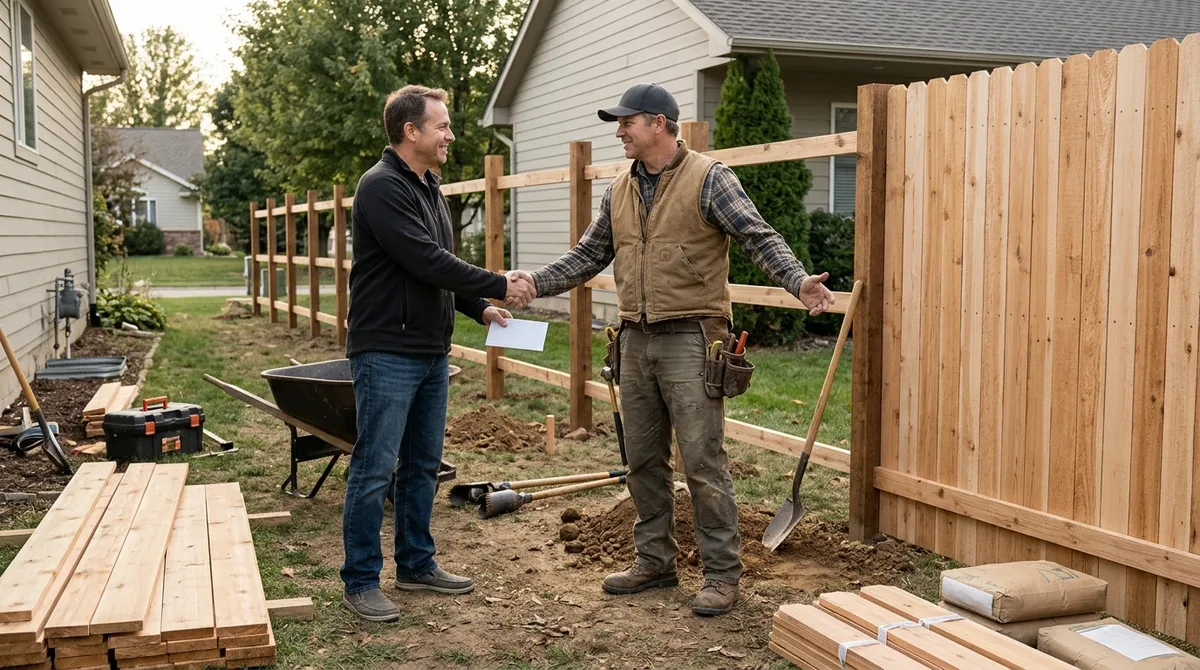
A fair fence payment schedule states the total price, separates the permitted down payment from later progress payments and the final balance, and ties each amount to a clear due date or project milestone. No single staged-payment percentage works for every job or every state. The schedule should fit the work, materials, and local rules rather than rely on a standard split.
At signing, check that the written contract lists the total price and down payment amount. It should also state each later payment amount or how that amount will be calculated, along with when each payment is due. A trigger such as delivery of specified materials or completion of a defined section of fence is clearer than a vague phrase like “payment as work progresses.”
For a covered California home-improvement contract, payments beyond the allowed down payment cannot exceed the value of work performed. The contract must also include a detailed written payment schedule. A later installment should correspond to completed work, not simply to a calendar date if the work has not reached the stated milestone.
New York guidance takes a related approach: progress payments must reasonably relate to work done, materials purchased, or other project-related costs. A schedule can identify those costs or milestones so you can compare the amount due with the project’s actual progress. For example, if a payment is tied to delivered fencing materials, the contract should identify the materials and make clear when delivery satisfies that milestone.
Published scheduling figures include an expected start about four weeks after a signed contract and deposit, and lead times of 8–10 weeks alongside a 30% materials deposit. These are not typical guarantees or recommendations. Whatever the proposed schedule, ask what each payment covers and whether the stated start timing depends on material delivery, permits, weather, or the contractor’s queue.
The contract should explain how a delay affects payment due dates. If materials arrive late or work pauses, the written terms should clarify whether a milestone moves with the work, what notice you will receive, and how revised dates will be agreed. Where practical, tie payments to observable progress, such as delivery of listed materials or completion of a stated section, rather than leaving timing open to interpretation.
Keep the final balance distinct from progress payments. Ohio consumer guidance recommends reserving final payment until the job is completed to your satisfaction. That is advice, not a legal rule for California. For your project, the contract should tie the final balance to completion and a final inspection, while explaining how any agreed punch-list items will be handled.
Before releasing the final balance, inspect the installed fence and gates against the written scope. Check that the specified material and layout are in place, the agreed work is complete, and any concerns are recorded. If the parties agree that a punch-list item remains, put the item, who will complete it, the expected timing, and how it affects the remaining balance in writing. Do not leave the amount or release condition for the final payment to an informal conversation.
A final inspection is useful only if the contract makes its role clear. State who will arrange it, how completion will be confirmed, and what happens if you identify unfinished or defective work. The Ohio recommendation to hold final payment until satisfactory completion is not a California legal requirement, but a written completion process can still help both sides understand when the final balance becomes due. A defined process also reduces the chance that a small remaining item turns into a disagreement over the whole payment schedule.
Read the schedule from the date you sign through the final inspection, not just the first payment line. Check that the total price adds up across the down payment, progress payments, and final balance, and that each due date or trigger is specific. If a payment is due before a milestone, ask the contractor to explain its basis in the contract and confirm that the arrangement complies with the law where the property is located.
Before you pay, require a written, signed contract and itemized quote that define the work, materials, fence placement, total price, deposit, payment schedule, responsibilities, timing, and terms for changes, delays, or cancellation. Use the checklist below to make sure the written terms match the fence project you expect and explain what happens if plans change.
A contract is easier to follow when the quote, project schedule, and payment terms use matching descriptions for the same work and materials. Before paying, ask for any missing placement detail, responsibility, timing, or material term to be added in writing.

You can spot a deposit request that deserves a closer look when the contractor pressures you to pay before you have reviewed signed terms, cannot explain what the money covers, or will not connect later payments to clear project milestones. Those signs call for questions and verification, not an automatic conclusion that the contractor is acting improperly. Pause and ask for written clarification if you encounter any of these:
A contractor should be able to explain the deposit and each later payment in plain terms. Ask what the initial payment covers, what event makes each later payment due, and how the schedule matches the written scope. If a payment is described as covering fence materials, check that the quote identifies those materials. If a charge does not relate to stated project costs, ask for an itemized explanation before sending money. Paying before you have reviewed a written contract is a reason to stop and ask for the terms first. In Pennsylvania, demanding or receiving payment before a home-improvement contract is signed is an offense under the applicable statute. Payment should follow the signed agreement, not pressure to send money so the contractor will put the terms in writing afterward. For a covered California home-improvement contract, compare the requested down payment with the limit of $1,000 or 10% of the contract price, whichever is less. Then review later payments separately: the schedule should clearly state when each payment is due, and payments should track work performed or materials delivered. A contractor’s explanation that an upfront amount is for materials does not, by itself, make the requested down payment appropriate under California’s limit. A 30% or 50% deposit shown in another company’s example is not a statewide rule and does not prove that the same request fits your project. The percentage alone leaves out the fence length, selected material, gates, project costs, state requirements, and what the contract says happens if the schedule changes. Compare the requested amount with your own written scope and local rules instead of treating another company’s policy as a benchmark. Before paying, verify that the contractor’s license is current with the relevant state licensing authority and ask for proof of insurance. Check that the business name on the license, insurance documents, quote, and contract is consistent. A request to send money to a different person or business name should prompt you to ask why and get the explanation in writing. Compare the payment schedule with the fence project described in the quote and contract. Check that the listed materials, gates, fence line, and installation work match the agreed scope. Confirm who is responsible for checking property boundaries and handling any required permits, and make sure the contract states those responsibilities. If the fence route or permit plan is still unsettled, ask how the contractor will confirm it before installation and whether it affects the planned start window. Ask the contractor to put delay and cancellation terms in the agreement. The terms should explain how you will be notified of a schedule change, whether payment milestones move if work or delivery is delayed, and how any refund or charge is determined if the project is canceled. If the contractor will not document those terms, or gives only a vague promise to “work it out,” pause before paying and request specific written language. Keep copies of the signed contract, quote, and payment records, including receipts and any written updates to the schedule or scope. Make sure the documents use consistent amounts and descriptions so you can tell what you agreed to pay and what each payment covers. A clear record makes it easier to compare what the contractor requests with the work and costs stated for your fence project.
After you pay the deposit, the contractor should document the payment, confirm the next project steps, provide scheduling updates, complete the agreed installation, and handle final payment under the contract and applicable law. Keep the process in writing so you can track what has been paid, what is happening next, and what remains to be done.
Keep a receipt or other written record showing the amount paid, payment date, fence project, and contract the payment applies to. Check that the receipt matches the contract’s stated deposit and payment method. Save the signed contract, quote, receipt, and any written updates together so the project record is easy to follow.
Ask the contractor to confirm what happens next and when each step is expected under the contract. For example, the next step may be ordering the listed materials, coordinating a required permit, or sending a scheduling update once the project is ready to move forward. Confirm who is responsible for permit coordination and whether permit approval affects the expected installation window. If the contract gives an expected date or milestone, ask the contractor to confirm it in writing.
A deposit does not guarantee a universal start date. Lead times can vary with the contractor’s queue, material availability, permits, and weather. Published lead-time figures range from about four weeks after a signed contract and deposit to 8–10 weeks. Treat those figures as general context, not a schedule that applies to every fence project. Ask how the expected timing applies to your materials and property, and request a written update if the schedule changes.
Once work is scheduled, keep updates about the start date and any delays with the contract records. If a material order, permit, or weather issue changes the plan, ask what changed and what the revised timing is. The contract should explain how delays affect the project schedule and payment milestones. Clear updates help you distinguish a changed start window from a change to the agreed scope or payment terms.
Installation time is separate from lead time, and it can vary by project. Published figures include a scheduling deposit of half the project cost, a balance due on completion, and an average project duration of 1–1½ weeks. These figures illustrate how deposit terms and timelines can differ; they are not a recommended schedule for a Los Angeles-area project. Check your own contract for the expected work duration and what the contractor will do if the job takes longer.
After installation, inspect the fence and gate against the written scope. Check that the agreed materials, layout, gates, and listed work are in place. Write down any unfinished or outstanding items, and share the list with the contractor so both sides have the same record. Follow the contract and applicable rules for the final payment, including any written process for completing agreed outstanding work. Do not assume the balance is due under another company’s example; use the payment terms for your project.
Before moving forward, contact us to discuss your project scope, materials, scheduling, and written payment terms for a Los Angeles-area installation. Keep the conversation, any revised schedule, inspection notes, and payment records together with your contract and receipt.
If you’re comparing a fence installation deposit, send us the details of your project in Los Angeles or the surrounding valley areas. Use our website to start a conversation about residential or commercial fence and gate installation.
In your request, name the material you’re considering, such as wood, chain link, wrought iron, vinyl, or high-security fencing. Include the approximate fence length, gate locations, and any existing fence removal or site preparation you want considered. If you’re still choosing a material, say so and ask which options fit the project.
Ask for written terms showing the proposed deposit in dollars, what it covers, the later payment milestones, and the expected start window. Ask how the agreement handles material delays, schedule changes, and cancellation. For a Los Angeles residential home-improvement project, compare the proposed down payment with California’s applicable limit before paying.
You can use this message: “I’m planning a [residential or commercial] [fence or gate] project in Los Angeles or the surrounding valley areas. I’m considering [material], with approximately [length] and [number of gates]. Please provide the project scope, written payment schedule, deposit terms, and expected start timing.”
When you receive the terms, check that the quote and contract describe the same materials and work before you decide whether to proceed.
Whether you can pay a fence installation deposit by credit card depends on the contractor’s accepted payment methods. Ask about any processing fee before paying, and get a receipt that records the amount and project.
Two property owners can split a fence installation deposit if the contractor agrees to accept separate payments. Have the contract or a written payment note show each person’s share while keeping the total deposit and payment schedule clear.
A signed contract is the starting point for the agreed fence deposit, so ask for a written explanation of any proposed change. If you agree to revise the amount, have the change documented in writing before paying the new amount.
A contractor may agree to split the deposit into installments if the written contract clearly states the amounts and due dates. For a covered California home-improvement contract, splitting the payment does not raise the down-payment limit: the total initial down payment may not exceed $1,000 or 10% of the contract price, whichever is less.
VIEW OUR WORK
LEARN MORE
CONNECT WITH US