
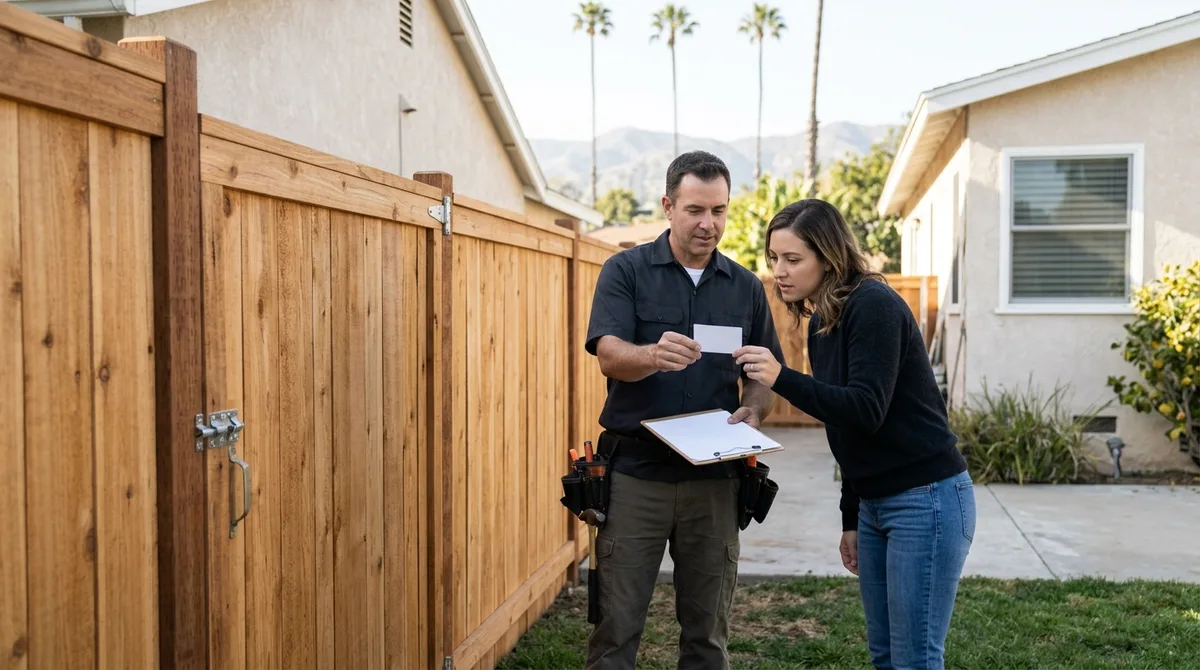
For most fence projects in California, check for a current California Contractors State License Board (CSLB) license with the C-13 Fencing Contractor classification. The C-13 scope includes fences, gates, railings, and barriers, but excludes masonry walls. Check that the classification fits the work you are planning. CSLB’s C-13 classification description explains the covered work. Checking a license is a practical first step before approving construction at your home or commercial property, but it is only one part of choosing a contractor.
Use CSLB’s Instant License Check to look up a contractor by business name, contractor name, or license number. Then compare the record with the estimate and proposed contract. Check the license status and complaint disclosures, and make sure the company and license holder match the information you received. CSLB’s Instant License Check provides those public details. In Los Angeles, keep licensing separate from local project approvals. Permit requirements can depend on fence material and height, while zoning rules can affect placement. As you review a bid, confirm who will do the work, which materials and gates are included, and whether the contractor’s experience fits your project. These checks can help you compare providers before you commit.
Yes. For most fence projects in California, look for a current CSLB license with the C-13 Fencing Contractor classification. C-13 work includes constructing, erecting, altering, or repairing fences, gates, railings, barriers, and related structures. The classification excludes masonry walls, so a C-13 license alone does not cover that part of a project.
California’s exemption for minor work is narrow. Unlicensed work may qualify only when the total project cost is under $1,000, no building permit is required, and the contractor uses no employees. All three conditions must be met. Satisfying only one or two is not enough.
A license is required if the work requires a building permit, uses employee labor, or has combined labor-and-material costs of $1,000 or more. Any one of those conditions triggers the requirement. A project also cannot be split into smaller contracts to make the individual amounts appear to fall below the threshold. CSLB’s contractor-license requirements explain when a license is required.
The cost test applies to the combined labor and materials for the project, not just the fence panels or other materials. For example, a job with a lower materials bill may still meet the threshold once labor is included. A job below the threshold may still require a license if a permit is needed or employees will do the work. The exemption is not a general allowance for contractors to take on larger jobs without the proper license.
For a substantial residential or commercial fence project, the small-project threshold is not a shortcut for deciding whether a contractor is qualified. Evaluate a large perimeter fence, multiple gates, or a project involving several fence sections based on the full scope and the contractor’s matching classification, not by dividing the work into separate prices. The same principle applies whether the property is a home, business, or other commercial site.
A license and a local permit answer different questions. The license relates to the contractor’s authority to perform regulated contracting work. It does not approve a fence’s design, location, or construction under local rules. Permit requirements can depend on the project, and zoning rules may separately affect fence height or placement. A contractor’s license also does not prove that the contractor is the right fit for your materials, layout, access needs, or gate requirements.
When reviewing a proposed job, make sure the work described in the estimate and contract matches the work the contractor is licensed to perform. If a project combines a fence with a masonry wall, treat those as distinct parts of the scope rather than assuming the fence classification covers both. A clear description of the work helps you understand what the license applies to and which approvals may need to be considered separately.
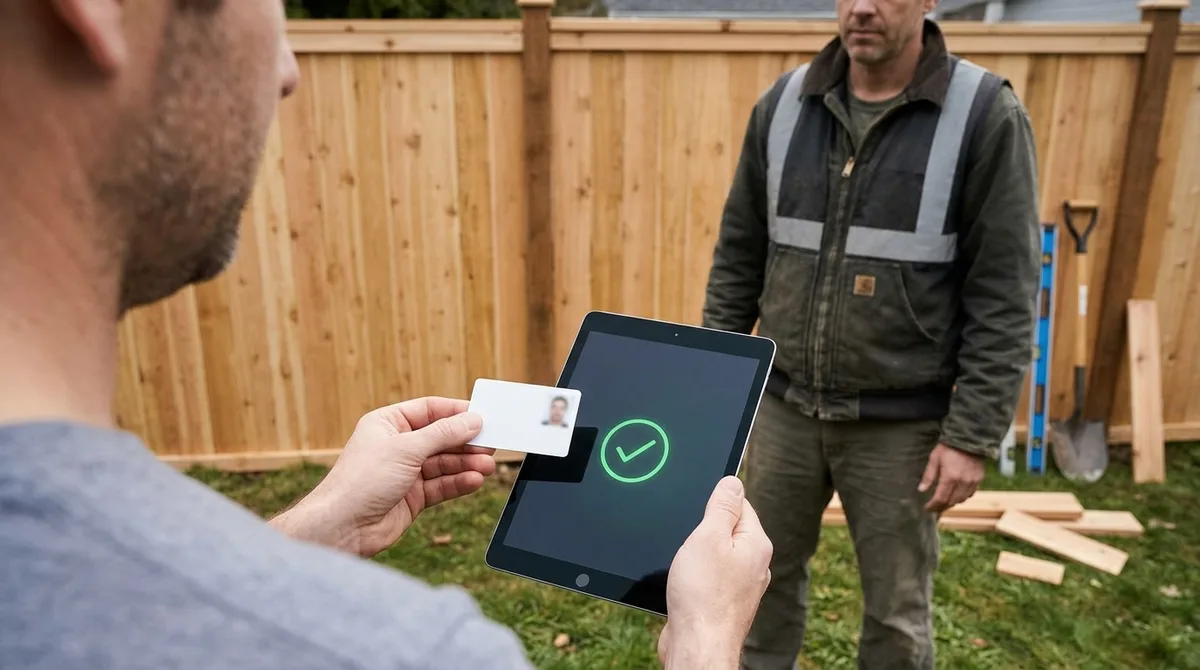
You can check a fence contractor’s C-13 license through CSLB’s Instant License Check. Compare the license record with the company and contracting party named on the bid and agreement. Have the proposed contractor’s business name, contractor name, or license number ready before you start.
Use the steps below to review the record and follow up on any details that do not match or are unclear.
Keep a copy of the license information you reviewed with the estimate and proposed agreement. If the contractor’s explanation changes the business name, contracting party, or license details you were given, check the updated information before approving the work.
Beyond the license, verify the contractor’s bond and workers’ compensation information, request current insurance documentation for the proposed work, confirm the legal business identity, and check experience with your type of fence or gate. A current license confirms a classification and status. It does not promise a particular installation result, schedule, or project outcome. Make sure you understand who will do the work and what the company has agreed to provide.
A contractor license bond and insurance coverage are different things. California requires a contractor license bond or cashier’s check in the amount of $25,000, and some licensees may also need a separate $25,000 qualifying-individual bond. CSLB’s bond information explains those license requirements. A bond entry in the license record is not proof of liability insurance or workers’ compensation coverage for your particular project.
Review the workers’ compensation information shown in the CSLB record, then ask the contractor for current documentation about workers’ compensation and liability insurance for the proposed work. Confirm which legal business is covered and whether the coverage applies to the crew expected at your property. If subcontractors will be involved, ask how their coverage is handled as well. If a record or document does not clearly match the company or workers performing the job, ask for clarification before work begins.
Make sure the contracting company’s legal business identity matches the CSLB record and the estimate. Compare the company name and license details on the paperwork, and ask for an explanation if the estimate uses a different name from the license record. Check who will sign the agreement and receive payment, too. Get the relationship between the parties in writing rather than relying on a verbal assurance.
A license does not tell you whether the contractor has handled the particular materials, layout, or gate features your project needs. Ask about relevant experience with the type of work in your plan, such as wood fencing, vinyl-coated chain link with privacy slats, wrought iron or steel, or an automatic driveway gate. A contractor’s ability to describe the proposed materials, installation approach, and site conditions can help you judge whether the experience is relevant. Ask for references from projects with a similar scope, and contact them with specific questions about communication, workmanship, and whether the work was completed as agreed.
Review the project documents alongside the license and insurance details. The estimate should identify the contracting company and describe the fence or gate work clearly enough for you to understand what is included. Check that material choices, gate features, and other agreed work appear in the written terms, and ask about anything vague or missing. A license cannot fill in an unclear scope or resolve a difference between what you discussed and what the agreement says.
Make sure the person or business named in the paperwork matches the party performing the work. Do not treat a low price or verbal promise as a replacement for verifying the license, company identity, and project documents. If an explanation about the license, bond, insurance, or crew does not line up, pause and get clear, current information before approving construction.
Keep copies of the license details you checked, the contractor’s insurance information, the estimate, and the signed agreement. Those records make it easier to compare what was represented with the company and scope you are authorizing. A careful review can help you choose a provider whose qualifications and documentation fit the work. Workmanship, schedule, and project coordination still need to be evaluated separately.
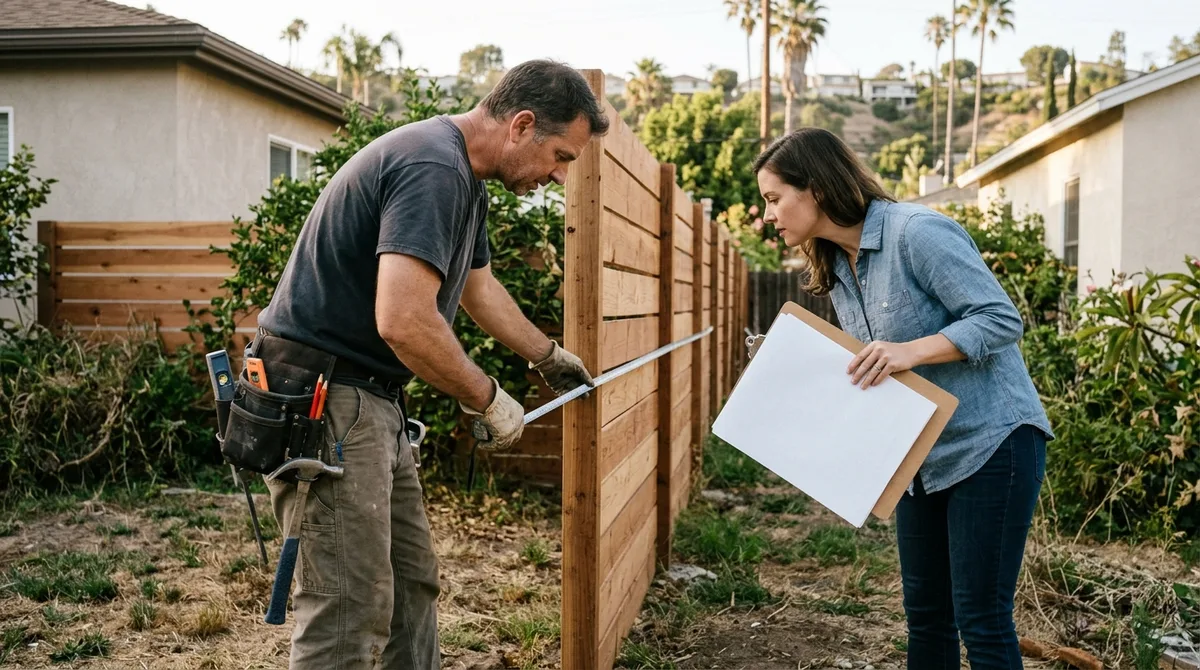
Permit approval and compliance with local fence rules are separate from a contractor’s license. The rules for your project depend on its exact location, material, height, and placement. A current C-13 license does not approve a fence design or confirm that a fence meets the rules for a particular property.
For properties within the City of Los Angeles, the 2023 Los Angeles Department of Building and Safety (LADBS) bulletin says a building permit is required for masonry or concrete fences over 3½ feet high, and for other fences over 10 feet high. The material matters: a masonry or concrete fence and a wood, vinyl, chain link, or metal fence can fall under different permit thresholds. Check the LADBS fence guidance for details that apply to the proposed construction.
The LADBS bulletin also describes a limited exception for certain partially masonry or concrete fence walls. Under that exception, no portion of the wall can exceed 6 feet; pilasters can be no more than 6 feet high and 1 foot 4 inches wide; and pilasters must be at least 6 feet apart on center. The exception depends on meeting all of those conditions, so do not assume that a mixed-material fence qualifies just because part of it is not masonry. Compare the proposed dimensions and construction with the bulletin before treating a permit as unnecessary.
A building-permit threshold does not determine every rule that may affect a fence. Zoning can separately affect allowable height and placement, including where a fence may sit in relation to a required yard. Los Angeles Municipal Code Section 12.24 X.7 allows a Zoning Administrator to consider applications for fences and walls up to 8 feet high in specified required yards in A and R zones where the code otherwise prohibits them. That provision is not a general allowance for an 8-foot fence everywhere. The location and zoning conditions matter. Los Angeles City Planning’s information on fences and walls explains the provision.
The proposed fence’s placement can be as important as its height. A fence below a building-permit threshold may still need to be assessed under zoning rules for its location. For example, check a plan for a tall privacy fence along a side or rear yard against the rules for that property’s zone and yard, rather than judging it only by material or overall height. Do not assume the rules for one part of a lot apply in the same way to every proposed fence section.
The City of Los Angeles rules described here apply within the City of Los Angeles, not automatically throughout the wider area served by Los Angeles Fence Builders. A property in Beverly Hills, Culver City, Santa Monica, Burbank, Glendale, or another surrounding community may be subject to a different local authority’s requirements. Even a nearby address can fall under a different jurisdiction, so identify the authority responsible for the project address before relying on a city-specific threshold.
When reviewing a proposed scope, write down the property address, fence material, planned height, and where the fence will sit on the property. Those details help you ask the right permitting and zoning questions. A plan involving chain link with privacy slats, a wood privacy fence, or a combination of metal and masonry may need a different review from a simple fence made of another material. Describe the construction accurately when checking local requirements.
Keep the permit question separate from the contractor-qualification question as you evaluate a project. The license record concerns the contractor; local approval concerns the proposed work at a particular address. Confirming one does not settle the other. For a property outside the City of Los Angeles, check with the authority for that address rather than applying LADBS guidance or Los Angeles City Planning rules across the entire service area.
Compare fence bids by matching the full written scope, materials, gates, site work, add-ons, and contract terms, rather than choosing by the headline price alone. A lower total may leave out removal, gate hardware, or site preparation that another estimate includes. Ask every bidder to describe the same work so you can compare what each price covers.
Start with the fence dimensions and layout. Ask each contractor to state the total fence length, planned height, and where each section will go. Have the estimate identify the material and finish for every section, including any changes in material around gates or along different parts of the property. If the bids use different assumptions about length, height, or layout, ask for revised estimates before comparing totals.
Check that each estimate explains what is included in the price. Ask whether it covers removal of an existing fence, disposal, clearing, grading, or other preparation. Have the contractor describe any site conditions that could affect the work, such as slopes, limited access, or obstacles along the fence line, and explain how changes in those conditions would be priced. A clear estimate should also identify excluded work so an omission does not become an unexpected cost later.
For gates, compare the number, location, size, material, and finish of each gate, along with the included hardware. A driveway gate may involve different requirements from a walk gate, and an automatic opener adds equipment and installation details that should be spelled out. If you are considering an automatic opener, ask whether the estimate includes the opener, controls, wiring or other connections, and related site work. For a security or high-security fence, ask the contractor to identify the specific components included rather than relying on a broad label.
Chain-link bids should specify whether the fence is galvanized or vinyl-coated. Ask contractors to identify any privacy slats or windscreen, and whether those options are included or priced separately. Barbed wire may also be an add-on where suitable for the property and project. Compare the complete configuration, including gates and security features, because a basic chain-link fence and one with added privacy or security components are not equivalent bids.
Experience should match the materials and features in the estimate. Ask each bidder about relevant work with the selected fence material, such as wood, vinyl, wrought iron or steel, or the particular chain-link finish and add-ons you are considering. If the project includes a driveway gate, automatic opener, or high-security component, ask who will handle that part and about their experience with similar installations. Their answers can help you judge whether the proposed scope matches their relevant capabilities.
Los Angeles Fence Builders’ published estimated prices are $20–$35 per linear foot for chain link, $40–$65 for wood, $40–$65 for vinyl, and $45–$60 for wrought iron. Treat those figures as estimates, not a guaranteed project total. Scope, material, terrain, and other project details can change the final quote. When comparing a bid with a per-foot range, check whether the estimate also accounts for gates, removal, preparation, hardware, finishes, and add-ons.
For California home-improvement projects over $500, a written contract is required, and the down payment generally cannot exceed $1,000 or 10% of the contract price, whichever is less. Review the contract against the estimate and make sure the written terms describe the work, materials, price, and payment arrangement you agreed to.
For qualifying California home-improvement contracts, buyers generally have three business days to cancel, or five business days if they are 65 or older. The usual right to cancel does not apply when the contract is negotiated at the contractor’s place of business. CSLB’s home-improvement contract guide explains the cancellation rules. Read the cancellation terms in the agreement and make sure you understand how they apply to your contract before signing.
A useful comparison is one where each contractor has priced the same fence length and height, material and finish, gate package, removal or preparation, site conditions, and add-ons. If an estimate leaves one of those details open, ask for a written clarification or revised price. This gives you a clearer basis for comparing bids without treating different project scopes as though they were the same.
Before hiring, confirm that the contractor’s license, insurance, company identity, relevant experience, and written project plan all match the work and property address. Use this short checklist to bring the key details together:
Then check whether the contractor’s experience fits the actual design, rather than relying on a general claim of fence-installation experience. Wood fencing, vinyl fencing, galvanized chain link, and vinyl-coated chain link each involve different material choices. Chain-link options may include privacy slats, windscreens, or barbed wire. For wrought iron or steel, cable wire railing, or security and high-security fencing, ask who will install the specified system and which parts the written scope includes.
Give gates their own review. Ask about experience with driveway gates and entry gates, and clarify whether automatic gate openers are part of the proposed work. For a project with several components, such as a commercial perimeter fence, security features, and an automatic entry gate, confirm that the contractor has relevant experience with each part. Make sure the agreement identifies the material and features you selected rather than using a broad description such as “metal fence” or “gate installation.”
Compare the company’s service area with the exact project address, not just the nearest well-known city. Los Angeles Fence Builders serves Los Angeles and surrounding San Fernando, San Gabriel, and San Bernardino Valley communities, including Beverly Hills, Bel-Air, Brentwood, Culver City, Hollywood, Santa Monica, Venice, Malibu, Pacific Palisades, the South Bay beach cities, Burbank, Glendale, Calabasas, Encino, Chatsworth, Granada Hills, North Hollywood, and Northridge. Because nearby properties can fall under different local authorities, the address matters when discussing the project’s permit plan.
We install fences and gates for residential and commercial properties. Our fence options include wood, vinyl, wrought iron, and chain link, including galvanized and vinyl-coated chain link. Chain-link add-ons include privacy slats, windscreens, and barbed wire. We offer free estimates.
You can discuss your proposed materials, gate features, security needs, and property address directly with us. Our business address is 1900 Hauser Blvd, Los Angeles, CA 90016, and our phone number is (424) 625-8561. Before approving any proposal, make sure the written scope, price, and permit plan reflect the specific work discussed.
To request a free fence estimate, call us at (424) 625-8561. Share the project address, whether the property is residential or commercial, and what you want the fence or gate to do. We serve Los Angeles and surrounding valley communities, including the San Fernando, San Gabriel, and San Bernardino Valleys.
A few project details can make the conversation more useful: the approximate fence length and height, your preferred material, and whether you need a driveway gate or entry gate. For chain link, tell us whether you’re considering galvanized or vinyl-coated fencing and whether privacy slats, a windscreen, or barbed wire are part of the plan. If you have a sketch or measurements, keep them nearby.
Ask us to identify the proposed materials, gate features, and any add-ons in the estimate so you can compare the written scope with your plans. For a commercial property, describe perimeter or security needs; for a home, mention privacy goals and access points. You can also discuss wood, vinyl, wrought iron, and chain-link options, including privacy slats, windscreens, and barbed wire.
We are located at 1900 Hauser Blvd, Los Angeles, CA 90016. Call us to discuss your project and request a free estimate.
A C-13 classification covers gate work, but its description does not specifically name automatic gate openers. Ask the contractor to list the opener and related controls or wiring in the scope, and confirm with CSLB that the license covers all the proposed work.
There is no single flat total for a California contractor’s license. Costs depend on CSLB charges and any applicable bond requirements. Check CSLB’s current fee schedule and bond rules when budgeting, and remember that a required bond is separate from a license fee.
To pursue a California C-13 license, apply through CSLB and meet its requirements for a qualifying individual, including at least four years of relevant experience within the preceding 10 years. The qualifying individual must have worked at journeyman level or as a foreman, supervising employee, or contractor. CSLB also sets application and license-issuance requirements.
No single fence material is best for every sloped property. The slope, layout, access, and privacy goals all matter. Ask the contractor to explain how the proposed fence will follow the grade and whether the design needs stepped sections or adjustments to avoid gaps.
VIEW OUR WORK
LEARN MORE
CONNECT WITH US